

 Nederlands
Blog series “Technical documentation and the power of AI”
It is the talk of the day: Artificial Intelligence, also known as AI. Whether it’s at the coffee machine at work, or during dinner with the family – The rapid development of AI is what everyone is talking about. From the huge impact it already has on our lives to the undiscovered possibilities (and challenges) that lie ahead. How does this affect our work and daily life?
At Foxiz we’re full of questions and ideas. By now, AI is part of the job for our technical writers, illustrators, translators, and consultants. We would like to take you with us on our journey of discovery. The thing is, we want to tell you so much; one blog simply doesn’t suffice. That’s why we’ve written an entire series of blogs on the matter, in which we highlight the different aspects of our job, as well as the impact AI has. Follow along as we explore AI.
Nr. 5 – Translating texts with AI
AI translations have rapidly become commonplace. With just a few clicks, a translation appears on your screen – fast, cheap, and of increasingly high quality. Google Translate, DeepL, ChatGPT: they have all become an integral part of the daily practice of anyone working with multilingual content. But does that mean that human translators are becoming redundant? And what are the risks of blindly relying on AI translations? In this blog we will list the main pros and cons of AI translations, illustrated with concrete and real-life examples.
The pros: faster, cheaper, and without human error
It’s easy to understand the appeal of AI translations. Whereas translations used to cost a substantial amount of money and could sometimes take weeks to complete, the barriers to entry are now extremely low.
- Speed: Translations often appear on your screen in mere seconds. For organisations operating globally that have to publish new content continuously, this is an unprecedented advantage.
- Cost reduction: Thanks to AI, many companies can drastically reduce their translation costs. Sometimes they even choose not to involve a translator at all.
- No human error: Additionally, AI does not make any human errors, such as misspellings or the mistyping of numbers.
It is therefore not surprising that AI translations are gaining ground. More and more companies are asking themselves: why pay for a human translator when a machine does the job ‘just as well’?
The cons: where AI fails
This brings us to the disadvantages of AI translations. Many people are convinced that AI translations are already virtually perfect or will be soon. That languages are simply data: ones and zeros you can store and link together. And that once you’ve done that perfectly, you’ve mastered the concept of ‘translation’. But this is a misconception.
In this blog we will share some examples of translation errors AI still regularly makes. These are not the popular examples shown on social media that, while quite funny, have little relevance to the field of technical writing and do not seriously highlight the risks. Instead, we will share real life examples of what we’ve recently seen in technical documentation at Foxiz.
1. Lack of context
AI often translates on a segment-per-segment basis (basically per sentence). As such, it often misses the context and broader cohesion of a text, a product, and/or an entire company. This sometimes ends up in confusing or even laughable translations. And even though such AI mishaps can be funny, it is of course not acceptable to have errors in a manual in which safety is paramount.


2. Poor handling of placeholders
Here’s another example. In technical documentation, we increasingly coordinate information. We start with a “single source of truth” and create references to that “single source of truth”, usually in the form of placeholders, cross-references, and so on. This is convenient because it means we only need to change something in one place and that change is then automatically implemented in all places where the relevant information is referenced.
This is common practice, particularly when writing in DITA/XML. Translation engines, however, do not always understand these placeholders because, again, they lack some context.
That product name with a ‘the’ in front of it… Is it “de” or “het” in Dutch? “Le” or “la” in French? And “der”, “die” or “das” in German? In equal fashion, an optional “s” to indicate plural does not work in all languages. The Italians, for example, don’t just add another letter; they change the last letter of the word. A common cross-reference worth mentioning is “see Figure 1”, followed by a cross-reference to “Figure 1”. However, there are languages, like Finnish, where the word for “Figure” is spelled differently depending on the context of the rest of the sentence.


3. Mistranslation of abbreviations
Abbreviations can sometimes be a real pain for AI. While common abbreviations like “ASAP” or “FYI” are usually understood perfectly fine, more uncommon and exotic abbreviations can trick AI. For instance, we recently came across a list of machine parts where every page referred to the relevant “juice numbers” (SAP-nummers in Dutch) – an embarrassing blunder. In another example, AI copied the abbreviation for personal protective equipment (PPE) rather than use the Dutch equivalent (PBM).


4. Blind trust of the source text
What about mistakes in the source text? We mentioned earlier that one of the advantages of translation engines is that they don’t make human errors like spelling mistakes. The downside is that they also don’t pick up on the human errors made by writers, whereas human translators would. This means a single typo can lead to a completely incorrect translation. This highlights the importance of a well-written source text. You can read more about this in our blog on writing with AI .


A single spelling mistake is one thing, but what about an English machine manual written by someone who barely speaks English at all? If you machine translate such texts, the translation often makes no sense at all.


5. Formatting issues
Incorrect use of enters, tabs or spaces, as is often seen in quick PDF-to-Word conversions, can also throw off AI. A sentence is chopped into pieces, and those separate pieces are translated individually, leading to warped results.


6. Buttons and software text
Another common example is buttons and screen texts. The machines that technical writers create documentation for naturally contain a range of buttons and/or software. Their function is of course explained in the documentation. How the names of buttons and their functions are referred to in the manual and how they actually appear on the machine must obviously correspond if you want the documentation to be properly understood.
But what of their translations? Should the names remain untranslated? Should they be translated bilingually? Should they be translated monolingually? Or is it better to give a description? And in case you choose to translate them: how? AI can’t see the machine and also won’t provide a consistent translation for all instances where a button is mentioned. It’ll choose a different option every time, resulting in inconsistency and confusion for the end user.

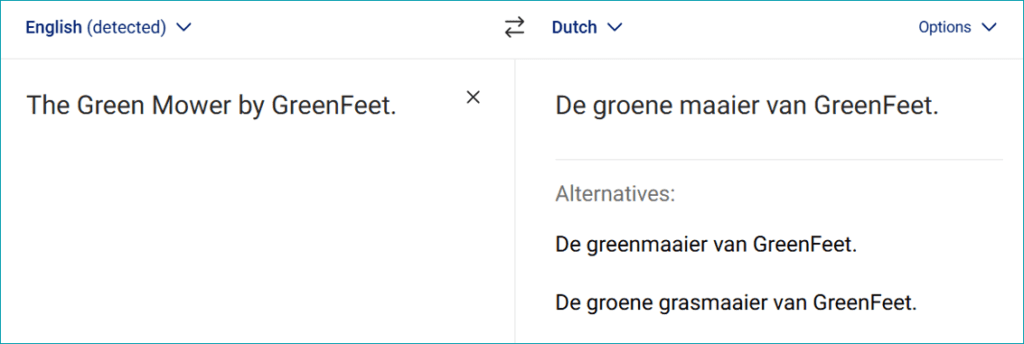
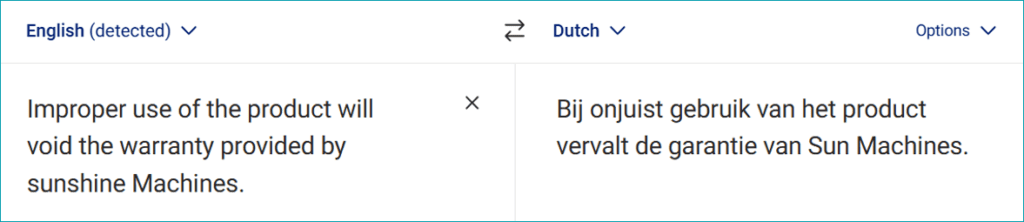
7. Company and product names
What about company and product names? AI doesn’t always understand that names should remain untranslated. The result? Awkward translations that undermine a company’s professional image.
8. Unintended changes
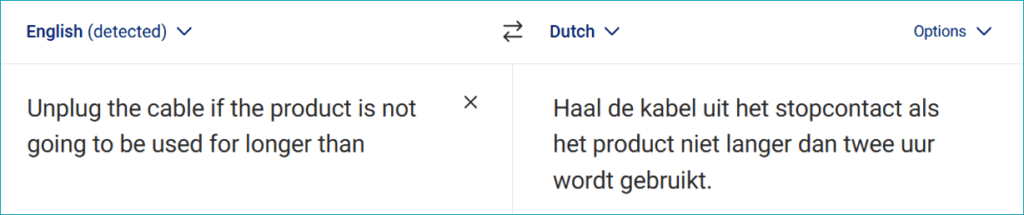
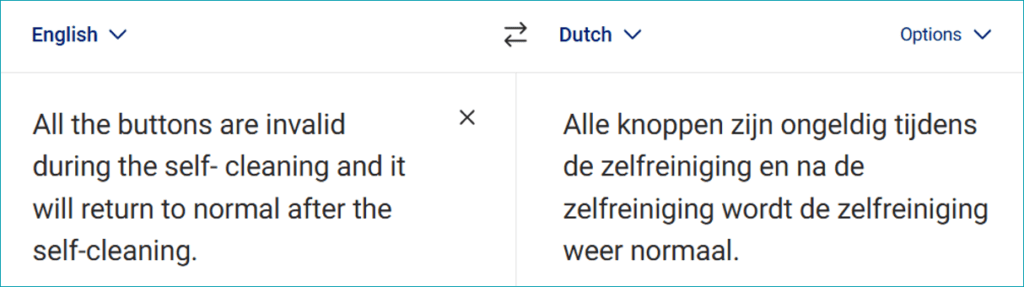
With the rise of AI, automatic translations have become much more fluent compared to the more static machine translations we used to know. However, the downside is that AI sometimes invents random details during translation that aren’t at all in the source text – the same “hallucinations” we also see in AI applications. This could, for instance, unintentionally change the meaning of a warning, with potentially disastrous consequences.

The risks: from embarrassing to dangerous
The consequences of incorrect AI translations may range from mildly comical and slightly embarrassing to downright dangerous. An awkward translation in a marketing brochure may damage your brand and an error in safety instructions could lead to injuries or legal claims.
Furthermore, there’s a significant risk when it comes to confidentiality. Anyone who enters sensitive documents in free AI tools or translation engines is sharing that information with third parties. These tools are trained on the data we feed them. While this is not always an issue, it can lead to dangerous situations when it comes to Defence-related documentation, for instance.
In a nutshell: anyone who trust AI translations blindly is playing with fire.
So what does work?
Should we completely disregard AI? Certainly not. The power of AI lies precisely in the collaboration between machine and human expertise.
Foxiz and AI
At Foxiz we are constantly trying to find out how we can combine the best of both worlds, together with our clients. This way, they can profit from shorter turnaround times and lower costs, while still receiving the translation quality they’re used to.
In need of proper technical documentation for your product or system? Want to pick our minds on how to improve your documentation and its translation? Or are you interested in a job as technical documentalist? Please contact us! We are happy to help you.
TIP: read our last blog on checking and fine-tuning a text with AI . In our next blog we’ll show you how to edit images with AI. Until then!